Enterprise AI in Practice
The executive playbook for moving from AI potential to governed enterprise value through strategy, operating models, use cases, architecture, agents, evaluation, security, adoption and measurable return.
Published as Kenny Tesky
Kenny Tesky is my publishing name. These books demonstrate research architecture, systems modelling, visual explanation and a human-directed AI-assisted method for turning complex subjects into practical executive choices.
Selected books
Enterprise AI establishes the adoption and operating model. The Financial Crime Operating System connects product, data, controls and responsible AI. Quantum Technology extends the portfolio into project-led emerging-technology judgement.
The executive playbook for moving from AI potential to governed enterprise value through strategy, operating models, use cases, architecture, agents, evaluation, security, adoption and measurable return.
An executive blueprint for unifying AML, fraud, sanctions, data and responsible AI into an operating system that connects policy, intelligence, workflows, decisions and evidence.
A hands-on path from quantum history to simulation and benchmarking, designed to help readers build, compare and decide rather than rely on hype or abstract possibility.
The portfolio value
Each book begins with a system boundary, a reader decision and a practical structure for moving from concept to evidence.
Publishing operating model
The books are not presented as autonomous AI output. They are knowledge products developed through a governed production system.
I direct the reader contract, book architecture, conceptual models, source standards, claim boundaries, review gates, visual direction and final publication approval. AI systems support research organisation, drafting, structural review, consistency checking and production tasks.
The same principle used in AFC Suite applies here: bounded execution, explicit authority and evidence before acceptance.
Establish the subject map, source register, claim boundaries and update risks before long-form drafting.
Define the reader journey, chapter objectives, knowledge dependencies and practical projects before expanding the manuscript.
Use separate structural, factual, visual and reader-experience checks rather than asking the drafting process to approve itself.
Retain final responsibility for claims, quality, confidentiality, design and release.
Product-to-publication loop
The Financial Crime Operating System is informed by lessons from AFC Suite without exposing customer-confidential or restricted implementation detail.
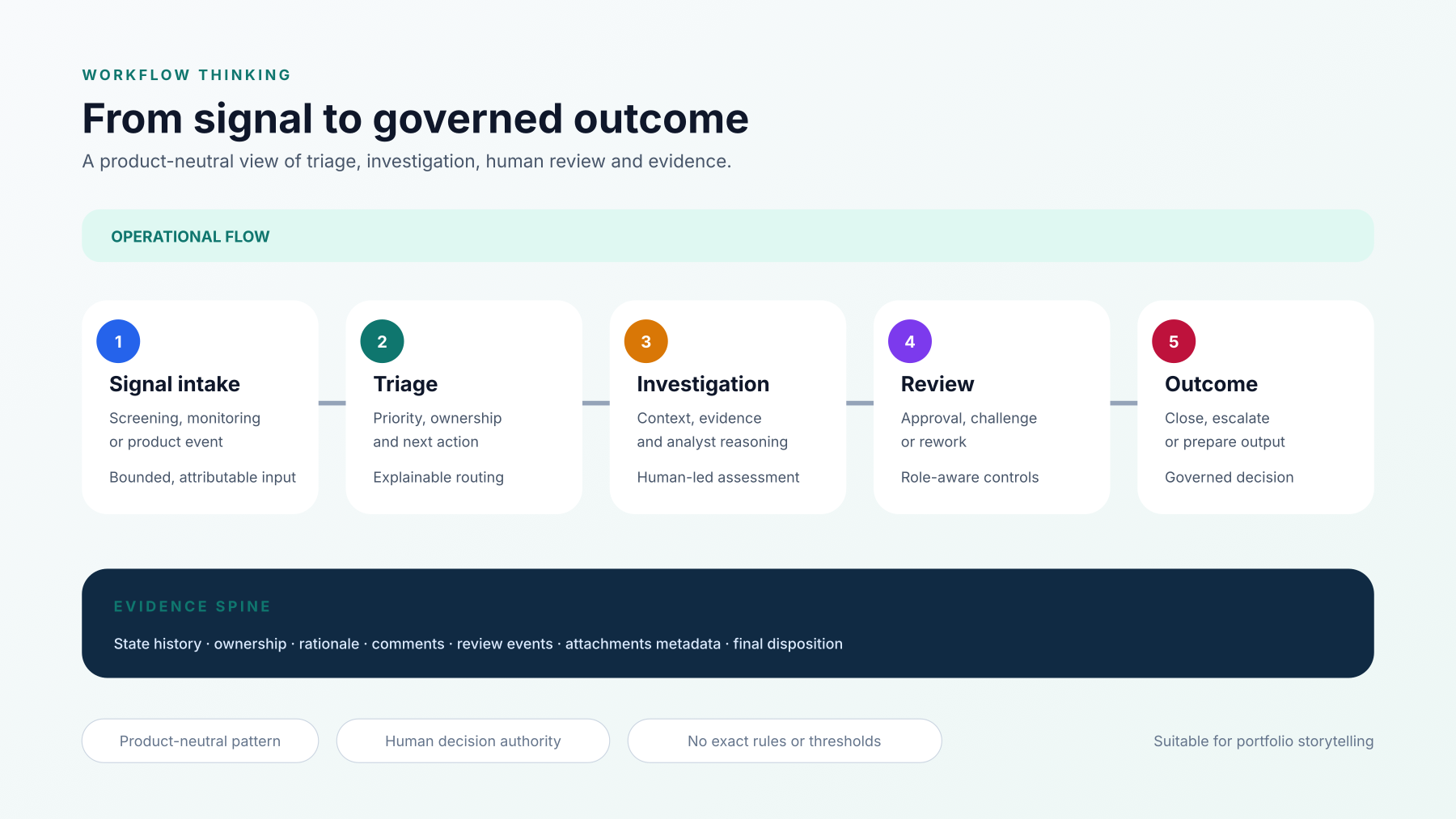
Work queues, decision rights, data gaps and evidence requirements reveal where an operating model must be explicit.
Research and writing connect product capabilities to policy, data, governance, human roles and technology choices.
Clearer layers and decision boundaries improve product scope, workflow design and architecture conversations.
The books are public evidence of how I structure complex domains and communicate decisions to executive and practitioner audiences.